


“The building of the future will be a materials bank, designed so that everything is ready to be reused.”
Architects are at the heart of the changes taking place in the way we live and the drive for sustainability that is fueling changes in the construction industry. Through their diverse and innovative visions, architects are inspiring, mobilizing and questioning, to get things moving. The series “Architects’ perspectives on sustainable construction” gives them a voice.
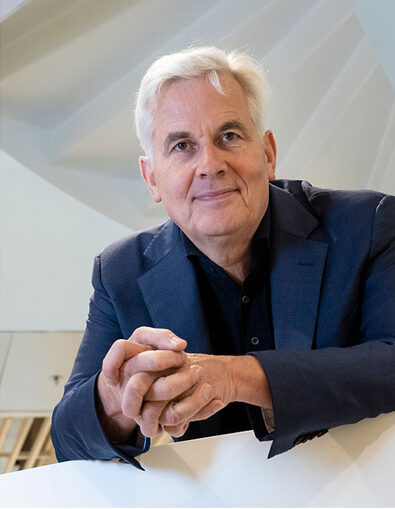
Thomas Rau is an architect renowned for his broad contribution to the development of sustainable architecture and for raising awareness of the circular economy. His firm, RAU Architects, is recognized as a pioneer in the production of innovative carbon-neutral, energy-positive and circular buildings. In 2016, he was nominated for the World Economic Forum’s Circular Economy Leadership award. He agreed to share his vision of architecture with us.
Do you think architects need a revolution?
I don’t think we need a revolution. We simply have to organize the reality that will follow the one we know now. In this future reality, we’ll have to completely change our outlook. For example, we will no longer be putting up buildings as we know them today. They will be more the result of a logistical process: a building will be a materials bank, designed so that everything is ready to be reused. Take waste, for example. This is the last vestige of the “old” system, regarded as material without identity, without value. But if you start registering waste using material passports, you give it a new identity, a value. It can then be transformed into new resources for new projects. Let’s treat waste like works of art!
So it’s less of a revolution and more the need for a profound change in our practices. We really need to keep in mind that, as human beings, we are “guests on Earth”. Nothing belongs to us. Starting from this premise, it will be possible to redesign our economy. Only this change in mindset will bring about a change in our climate trajectory.
Waste is the last vestige of the ‘old’ system.
As an expert in circularity, do you consider it to be a sustainable practice?
Sustainability has nothing to do with circularity. Sustainability means optimizing the existing system. Circularity means changing it into a new system. So the concept of circularity is quite distinct from sustainability. You can build a sustainable building that isn’t circular and, conversely, design a circular building that isn’t sustainable.
Do you think we have enough training to speed up the transition?
This is a fundamental question. Today, most people think it’s enough to be clever, to reuse, to minimize, and so on. In my view, we need to broaden our scope and completely change our attitude: it’s about realizing that we are just guests on planet Earth. In no way are we the hosts. The Earth operates in a closed circuit with limited resources, so we have to take care of everything it offers us. You can guess from my answer that, in the face of climate change, what I think we need most is a radical change of mindset. What makes life possible? This is humanity’s grand agenda for the years to come, to realize that we are dependent on everything, and that as guests, we need to change our attitude.
Today, most people think it’s enough to be clever, to reuse, to minimize, and so on. In my view, we need to broaden our scope and completely change our attitude
The answer in video form:

Triodos Bank (Netherlands)
The example chosen by Thomas RAU
The building was designed as a materials bank, with all physical components indexed and recorded on the Madaster platform to facilitate reuse in case the building is ever dismantled. Assembled using 165,312 screws, the structure can be fully deconstructed, enabling a 100% circular potential without any loss in the value of materials, components, or products.
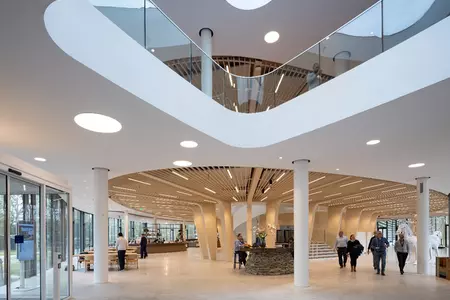
Triodos Bank (Netherlands), designed by RAU Architects and Ex Interiors, is the first wooden office building that can be completely dismantled. Triodos Bank was awarded the BREAAM Outstanding certificate and several other awards such as The Architecture MasterPrize™ 2020 in Green architecture. Credits: Ossip van Duivenbode